There are places in the world where you can watch whales from shore. And then there is Depoe Bay, Oregon — a place so uniquely positioned on the Pacific headlands that whale watching isn't an occasional bonus, it is a defining feature of daily life. If you've ever stood on the seawall here during migration season and watched a gray whale surface fifty yards offshore, you understand something essential about why people fall in love with this small town and never entirely leave.
Depoe Bay holds the official designation of the "World's Smallest Navigable Harbor," but in whale watching circles, it's known for something more important: its position directly on the migration corridor of the Eastern Pacific gray whale, combined with rocky headlands that push the deep water close to shore. The combination of geography, accessible viewing points, and an unusually high concentration of year-round resident whales makes this one of the most remarkable marine wildlife destinations on the West Coast — and you don't need a boat to experience it.
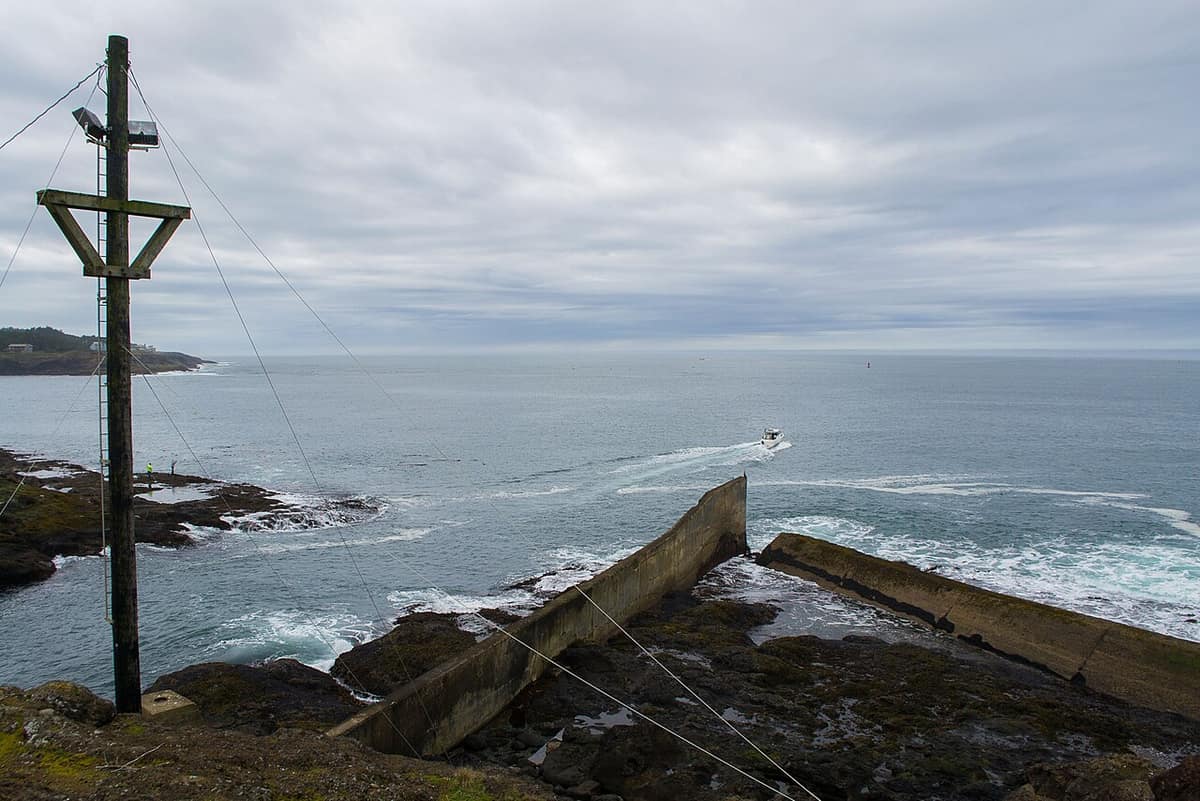
A boat heads out of Depoe Bay's harbor channel into the open Pacific, where whale watchers look for spouts — Photo: Visitor7 / Wikimedia Commons (CC BY-SA 3.0)
The Migration: Two Seasons, Thousands of Whales
The Eastern Pacific gray whale population makes one of the longest migrations of any mammal on earth — roughly 10,000 to 12,000 miles each way between their Arctic feeding grounds in the Bering and Chukchi Seas and their winter calving lagoons in Baja California, Mexico. Every year, more than 18,000 gray whales make this journey, and the route takes them directly past Depoe Bay.
The southbound migration runs from approximately mid-December through January. Whales are moving with purpose — pregnant females heading toward the warm lagoons to give birth, other adults following the familiar coastal pathway they've traveled their entire lives. Viewing during this period is often excellent because the whales travel close to shore and are highly visible from the headlands on calm days.
The northbound migration, from late February through April, is widely considered the better show. Mother-calf pairs travel slowly and close to the kelp beds. Calves born in January and February are curious, energetic, and prone to breaching, spy-hopping, and generally making themselves visible. This is when you'll see naturalists describing behaviors in real time from the headlands with spotting scopes. Peak viewing for the northbound migration typically falls in late March and early April.
Whale Watch Week: Oregon's Free Front-Row Seat
Oregon State University Extension Service and NOAA co-coordinate Whale Watch Week twice each year — once in late December to coincide with the southbound peak, and once in late March for the northbound migration. During these weeks, trained volunteer naturalists set up at designated headland sites along the Oregon Coast with high-powered spotting scopes, educational materials, and the knowledge to help visitors identify and interpret what they're seeing.
In Depoe Bay, the primary Whale Watch Week station is positioned at the headlands with a direct sight line over the deepwater channel. During a good morning, naturalists may call out dozens of individual sightings. The program is entirely free, open to the public, and staffed by some of the most knowledgeable marine wildlife volunteers on the coast. There is no better introduction to gray whale behavior than spending an hour with one of these naturalists during a peak migration day.
The Resident Pod: Whales That Never Leave
What makes Depoe Bay genuinely unusual — even compared to other outstanding Oregon whale watching sites — is the presence of a small resident pod of gray whales that does not migrate at all. While the larger population heads to the Bering Sea each spring, these whales, known informally as the Pacific Coast Feeding Group, remain along the Oregon and Washington coastlines year-round, feeding on ghost shrimp and other nearshore prey in the shallow rocky reefs.
Several of these whales have individual markings — unique fluke patterns, scars, distinctive pigmentation — that allow researchers and experienced guides to recognize them on repeat visits. Longtime Depoe Bay residents sometimes develop a familiarity with individual animals that spans years. This is not a seasonal attraction. In any month of the year, standing at the harbor seawall or the Whale Cove overlook, there is a meaningful chance you will see a whale.
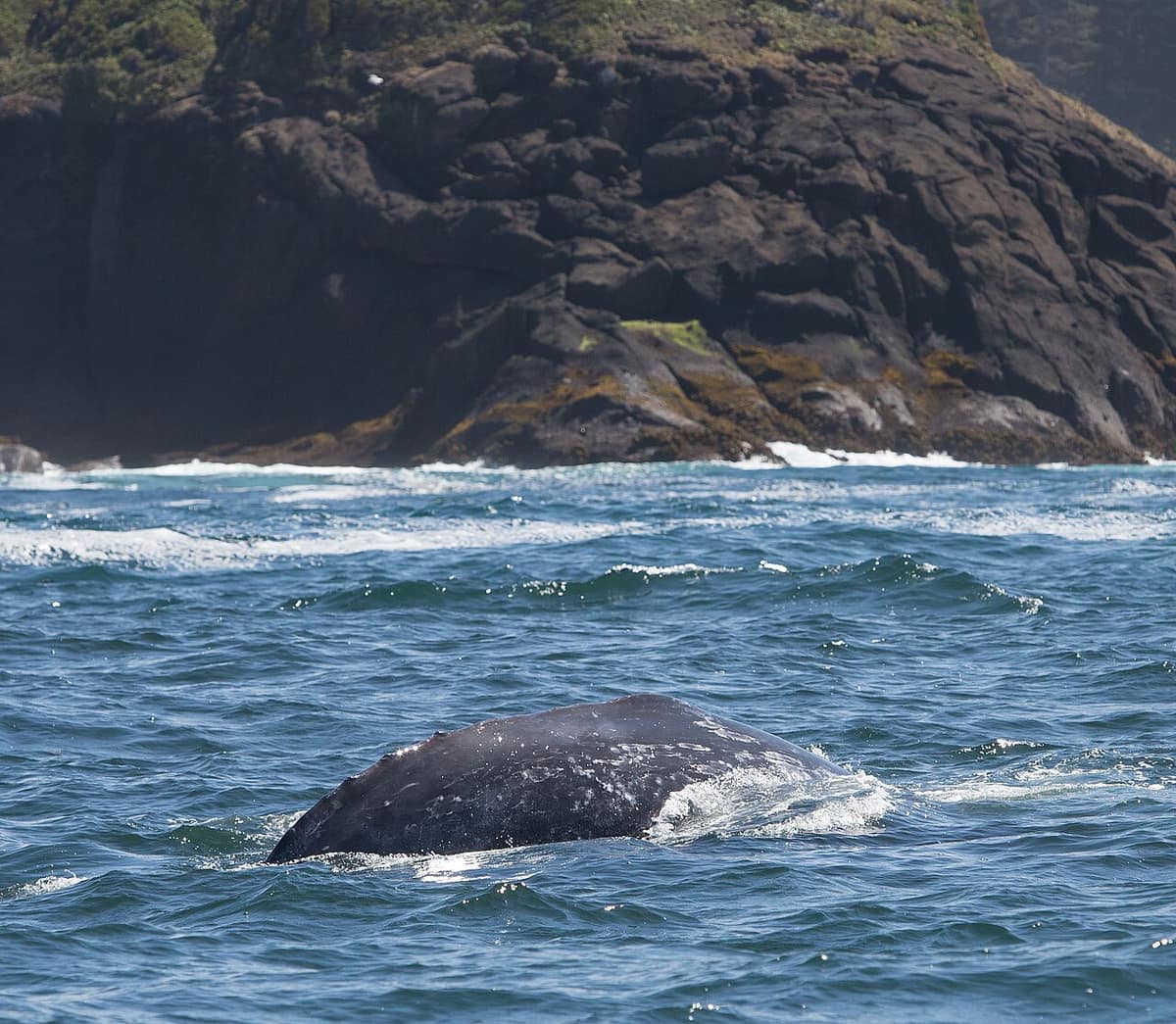
A gray whale surfaces close to the rocks at Depoe Bay — during migration season, whales pass within sight of shore — Photo: Nicki Dugan Pogue from San Francisco, USA / Wikimedia Commons (CC BY-SA 2.0)
Best Shore-Based Viewing Spots
You don't need a charter boat to see whales in Depoe Bay, though charters are available and excellent. The shoreside viewing options are among the best anywhere on the Pacific Coast:
- The Harbor Wall / Seawall (Hwy 101): The most accessible spot, directly adjacent to the world's smallest harbor. During migration season this is often crowded for good reason — the channel puts you directly over deep water, and whales pass close.
- Boiler Bay State Scenic Viewpoint: Located about a mile north of town, Boiler Bay is a designated Whale Watch Week site and offers elevated views over a rocky cove. Excellent for scanning the horizon during peak migration.
- Rocky Creek State Scenic Viewpoint: South of Depoe Bay, this viewpoint sits on a prominent headland with wide ocean views. Good for both northbound and southbound migration watching.
- Whale Cove Overlook: A small, protected cove south of town that is a known feeding area for the resident gray whales. This is where patience pays off — come prepared to wait and watch.
Charter Whale Watching from the Harbor
For those who want to get closer, whale watching charter boats depart from Depoe Bay's harbor — navigating through what may be the narrowest harbor entrance on the Pacific Coast before heading into open water. The channel is only about 50 feet wide, and watching a captain thread a boat through on a calm day is its own form of theater. Charter trips typically last two to three hours, venture a few miles offshore, and frequently encounter both resident and migrating whales at extremely close range.
The charter experience is complementary to shore watching, not a replacement. Some of the most memorable whale encounters happen from the seawall, when a whale surfaces unexpectedly twenty yards from shore while you're standing above the spouting horn listening to it exhale.
What It's Like to Own a Home Here
It is not unusual for a weekend of whale watching in Depoe Bay to turn into a serious home search. The experience of watching a gray whale breach from your living room window — or from a deck overlooking the harbor during your morning coffee — is genuinely life-altering for people who connect with the ocean on that level.
West-facing properties in Depoe Bay command a meaningful premium for exactly this reason. A harbor-view or oceanfront home here isn't just about aesthetics or vacation rental income potential, though both are real. It's about the quality of daily life for the people who live here year-round. Whale watching isn't something you drive to a parking lot for. It's something you do between breakfast and your first work call, and again in the evening when the light is right.
The Takeaway on Oceanfront and Harbor-View Properties: In Depoe Bay, a west-facing view is one of the most valuable things a property can offer — and it's priced accordingly, with values varying widely by proximity and unobstructed sightlines. If watching wildlife from your own window is part of what you're buying, this is one of the very few places on earth where that view delivers every day of the year, not just during summer.
For buyers considering Depoe Bay, the whale watching access is not a marketing point. It is a core feature of the asset you are acquiring. Properties with unobstructed westward views over the Pacific hold a lasting appeal, because the thing people come here for — that direct, visceral connection with one of the great wild spectacles of the Oregon Coast — never gets old.
Related reading