There are natural wonders on the Oregon Coast that most people have heard of — Cannon Beach's Haystack Rock, the Sea Lion Caves, the Cape Perpetua viewpoint. And then there are the Oregon Dunes, which people who haven't stood at the top of a 500-foot sand ridge looking west toward the Pacific Ocean struggle to fully picture. The Oregon Dunes National Recreation Area is the largest expanse of coastal sand dunes in North America. It stretches 40 miles from Florence south toward Coos Bay, and it is managed by the U.S. Forest Service as a National Recreation Area. For buyers considering Florence, the dunes are not a background amenity — they are a defining feature of what it means to live here, and they deserve a serious, honest examination.
This piece offers a buyer's-eye view of the dunes: what they actually look like from a daily-life perspective, what the different zones mean for property selection, what the sound environment is like near motorized areas, and why proximity to public land of this scale is one of the most durable value factors in any real estate market.
What the Oregon Dunes Actually Are
The Oregon Dunes National Recreation Area runs from the Siuslaw River at Florence's edge south to the Coos Bay area, covering approximately 40 miles of coastline. Some dunes reach heights of approximately 500 feet — these are not gentle sand hills but genuine dune formations, built over thousands of years from wind-deposited ocean sand. Pockets of Sitka spruce and shore pine forest push into the dune landscape, creating a mosaic environment unlike any other landscape in the Pacific Northwest. There are freshwater lakes hidden within the dunes. There are open sand sheets that extend to the ocean horizon. There are transition zones where forest and open sand meet in visually dramatic fashion.
The entire area is managed by the U.S. Forest Service, which means the public land will remain exactly that — permanently public, permanently accessible, permanently protected from development. For a buyer thinking about long-term value, adjacent public land that can never be developed is one of the most stable property value anchors that exists.
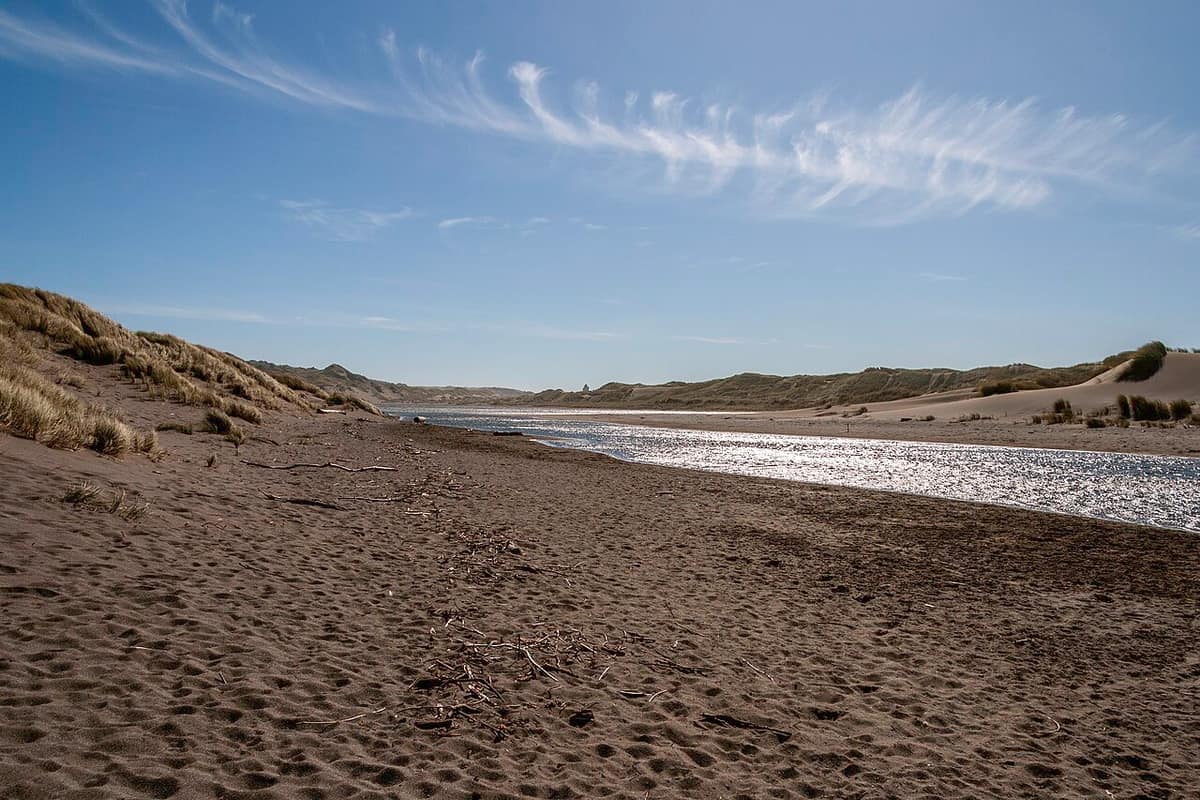
Open sand and dune grass in the Oregon Dunes National Recreation Area, one of the most dramatic landscapes on the Pacific Coast — Photo: Acroterion / Wikimedia Commons (CC BY-SA 4.0)
The Two Worlds of the Dunes
This is the most important thing for buyers to understand about the Oregon Dunes NRA, and it's a distinction that matters significantly for property selection.
Motorized / OHV Areas
A substantial portion of the Oregon Dunes NRA is designated for off-highway vehicle use — ATVs, dune buggies, and sand rails are permitted in designated OHV areas. This is a major draw for a specific buyer demographic, and the spring and summer OHV season brings significant visitor traffic to Florence from Eugene, the Willamette Valley, and the broader Pacific Northwest. If you own property adjacent to or near motorized dune areas, the sound environment during peak season is genuinely noisy. This is not a criticism — the OHV areas are a legitimate and popular use of the NRA, and they're part of what gives Florence its particular character as an outdoor recreation destination. But buyers who are expecting the dunes to provide a quiet, wilderness buffer should understand which areas allow motorized access before selecting a property.
Non-Motorized / Wilderness Areas
The NRA also includes non-motorized wilderness areas where the silence is complete and the experience is genuinely remote. Hiking trails wind through open sand, coastal forest, and dune transition zones. The contrast between open dune and dense Sitka spruce is visually striking. Sandboarding — using a board on the dune faces like snowboarding on sand — is popular in non-motorized areas and requires no engine. The wilderness character of these sections is protected and managed accordingly, and the experience of a long walk through the non-motorized dunes on a quiet weekday is unlike any other outdoor experience on the Oregon Coast.
What Living Near the Dunes Actually Looks Like
Some Florence homes are literally within walking or biking distance of dune access points. This isn't a figure of speech — there are residential properties where the dune landscape begins within a few hundred feet. For buyers who want the outdoor recreation lifestyle that the dunes offer, proximity translates directly into quality of daily life. You can walk to a trailhead from your front door. You can be on open sand within ten minutes of leaving the house. That kind of access is what people move to Florence specifically to have.
The practical implications of dune proximity vary by location. In motorized-access zones, spring and summer bring ATV traffic that can be heard from neighboring properties — this is real, and buyers should visit during a spring weekend to experience the sound environment firsthand before purchasing near OHV areas. In non-motorized zones, the landscape is quiet year-round, with the main sound being wind and the occasional hiker. Knowing which zone is adjacent to a property you're considering is essential homework.
Sandboarding
Sandboarding has developed its own community in the Florence area, among residents and visitors alike. The dune faces that are open to non-motorized use provide excellent runs, and the sport requires no special equipment beyond a board and a willingness to hike back up. It's one of the outdoor activities that genuinely differentiates Florence from any other Oregon Coast town.
Horseback Riding
The Oregon Dunes NRA is one of relatively few places in Oregon where horseback riding in the coastal dunes is possible. Riding on open sand with ocean views from dune ridgelines is an experience with very few equivalents in the Pacific Northwest, and it draws equestrian visitors and residents to the Florence area in ways that most coastal towns don't see.
Whale Watching from Dune Tops
From the higher dune ridges, the Pacific Ocean is visible to the west. During migration seasons, whale watching from dune crests is genuinely productive — the elevation gives a sightline advantage over sea-level beach positions. It's the kind of experience that requires only a short hike from accessible trailheads near Florence, and it's one of the things that makes living here feel genuinely different from being a visitor.
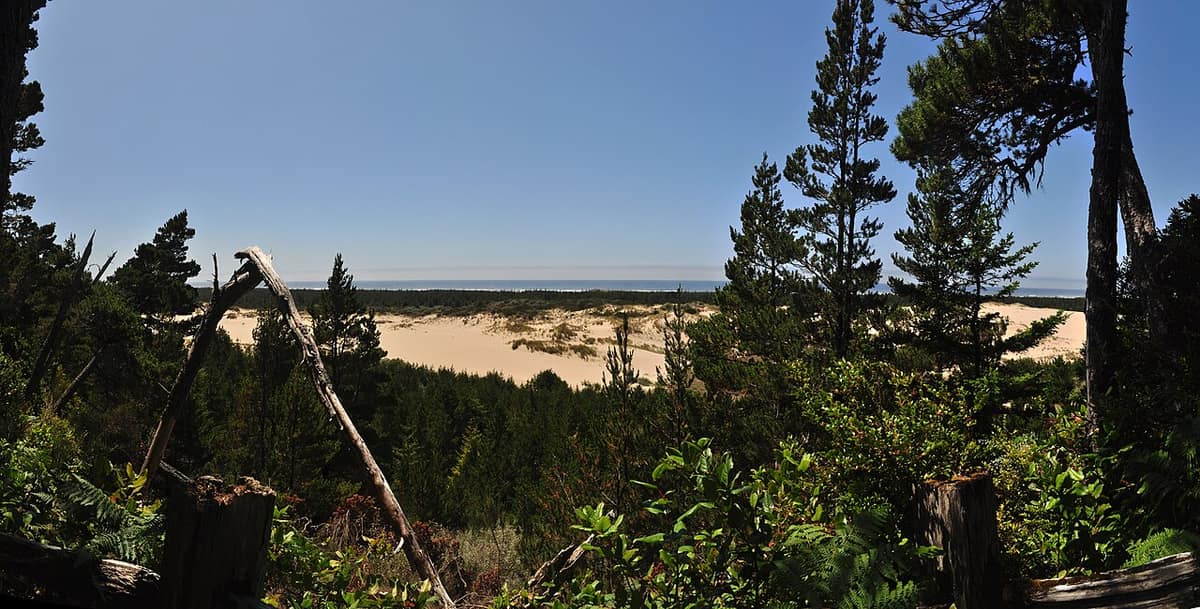
Forest gives way to open sand in the Oregon Dunes, with the Pacific on the horizon — a landscape unlike anywhere else in Oregon — Photo: Joe Mabel / Wikimedia Commons (CC BY-SA 3.0)
Honeyman State Park: The Lakes in the Dunes
Jessie M. Honeyman Memorial State Park sits within the dune landscape just south of Florence and contains freshwater lakes — Cleawox Lake and Woahink Lake — embedded within the dune system. Swimming, kayaking, stand-up paddleboarding, and camping at Honeyman are among the most popular summer activities in the area. The contrast between cool freshwater swimming and the surrounding sand dunes is a surreal Pacific Northwest experience that draws visitors from across Oregon every summer. For year-round Florence residents, Honeyman is an accessible amenity on a weekday morning when the visitor crowds are absent.
The Property Value Case for Adjacent Public Land
From a real estate perspective, permanent public land adjacency is one of the strongest long-term value factors in any residential market. The Oregon Dunes NRA cannot be developed. It cannot be sold to a private buyer. It will not become a subdivision or a commercial corridor. Properties that border or are immediately adjacent to the NRA have a permanent landscape buffer that protects their character and their views in a way that no private property can guarantee.
This is particularly significant in a small coastal town like Florence, where growth pressure from Eugene and the Willamette Valley is real and the developable land base is constrained by geography. Over time, proximity to the dunes is a value anchor, not just an amenity. Buyers who understand this dynamic aren't just buying access to recreation — they're buying permanence.
The Takeaway: Before you buy near the Oregon Dunes, visit during a busy spring weekend to experience the actual sound and activity levels in OHV zones, so you buy with eyes open. Then weigh what permanent adjacency to 40 miles of federally protected land means for your home long-term. There is nothing like the Oregon Dunes anywhere else on the Pacific Coast, and Florence is its northern gateway. That's a genuine distinction.
Practical Notes for Buyers
- Confirm which NRA zone (motorized vs. non-motorized) is adjacent to any dune-proximity property before making an offer.
- Visit the area during spring OHV season (typically April–September) if sound environment is a consideration in your property selection.
- Nearest dune access points from Florence residential areas typically range from 1–3 miles depending on neighborhood.
- USFS day-use fees apply at many dune access points — an America the Beautiful annual pass covers these and is widely used by Florence residents.
- Some dune-adjacent properties sit in or near FEMA-mapped hazard areas for sand movement — confirm with your agent and lender before purchasing.
Related reading