Heceta Head Lighthouse is a white tower on a green headland, and it shows up on the coast where Highway 101 curls above a cove north of Florence. It is the kind of place that looks painted from the road and turns out to be real once you are standing on the path. Next door on the same stretch of highway sits Sea Lion Caves, a very different kind of stop that draws people for the animals rather than the architecture. Together they make one of the best half-days on the central Oregon Coast, and both are close enough to Florence that locals treat them as the neighborhood.
Heceta Head Lighthouse: What You’re Looking At
According to Oregon State Parks, the tower was built between 1892 and 1893 and first lit in 1894. The tower itself is 56 feet tall, but it stands 206 feet above the Pacific, which is why the beacon is described as visible from 21 miles out and as the strongest light on the Oregon coast. The lighthouse was listed on the National Register of Historic Places in 1978 and became fully automated in 1963.
The assistant lightkeeper’s house, built in 1893, is one of the last of its kind remaining on the Pacific Coast, and today it operates as a bed and breakfast run by a Forest Service concessionaire. The head keeper’s house is gone. The site itself began life as Devil’s Elbow State Park, a cove park south of the lighthouse, and was enlarged and renamed when the state acquired the surrounding land.
If you want to see the lens up close, the state parks page notes that a trail before the lighthouse leads to a viewpoint of the lens, and that the ground floor has been open on a limited schedule when weather and staffing allow. That schedule changes, so check current hours and access with Oregon State Parks before you go.
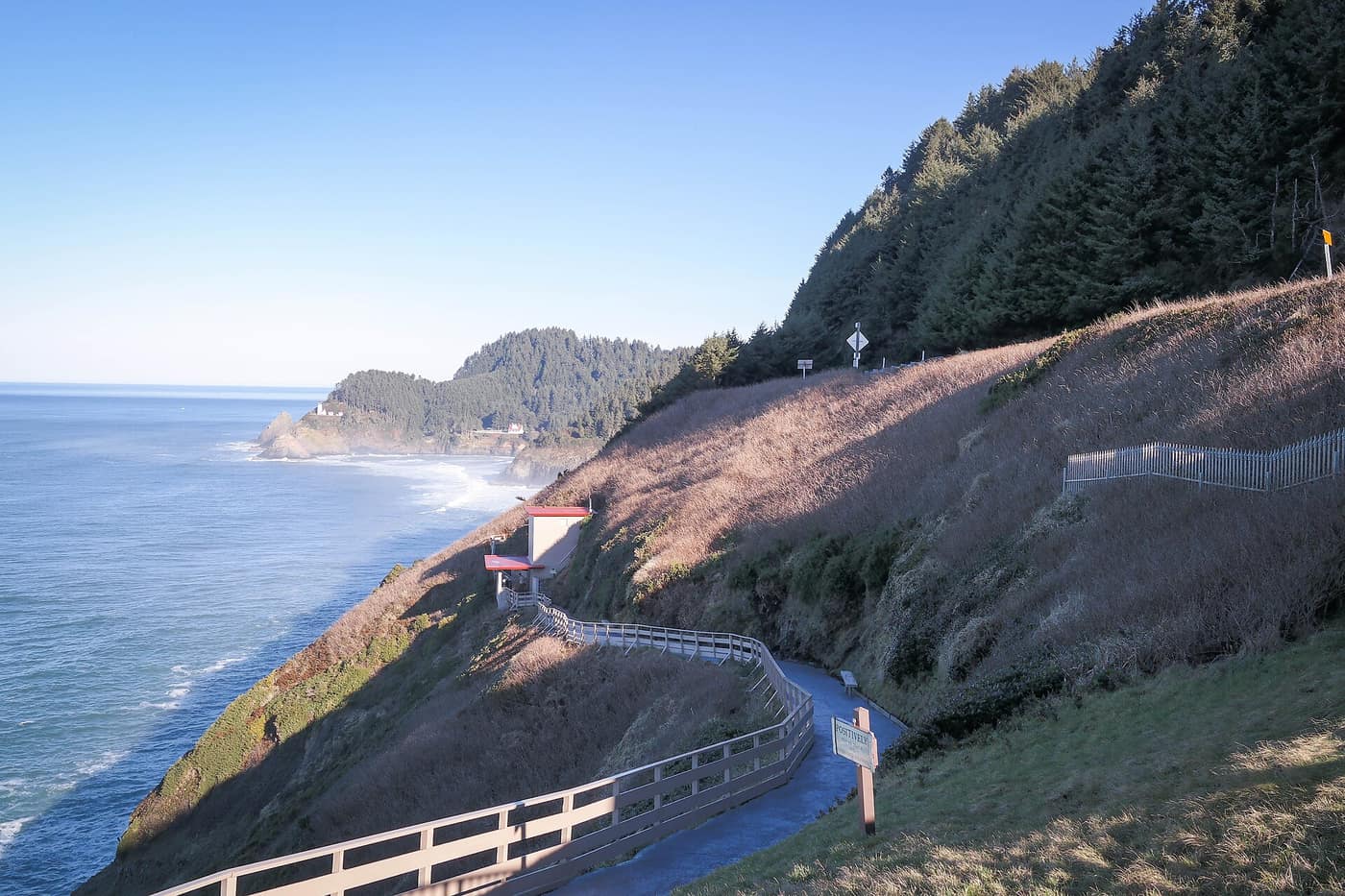
The approach to Sea Lion Caves along the cliffs north of Florence, with the Heceta Head headland in the distance — Photo: Visitor7 / Wikimedia Commons (CC BY-SA 3.0)
How Hard Is the Walk to Heceta Head Lighthouse?
Easier than it looks. State parks describes the trail to the lighthouse as half a mile long, beginning at the parking area and passing the lightkeeper’s house, with a climb of 150 feet. That is a steady uphill walk, not a hike, and most people take it slowly so they can stop and look back at the cove. There is no public vehicle access to the lighthouse itself, so everyone arrives on foot.
If you want more than the lighthouse, a forested trail network of about seven miles, part of the Oregon Coast Trail, continues behind the lighthouse and drops steeply toward Washburne campground and the beach. Hikers on those trails may spot Roosevelt elk and marbled murrelets. A sheltered beach near the parking lot is easy to reach for anyone who would rather skip the climb.
One more landmark worth finding from the lighthouse path: the long concrete arch of the Cape Creek Bridge, where Highway 101 crosses the cove below the headland. It is one of those pieces of road engineering that looks better from a distance, and the lighthouse trail gives you exactly that distance.
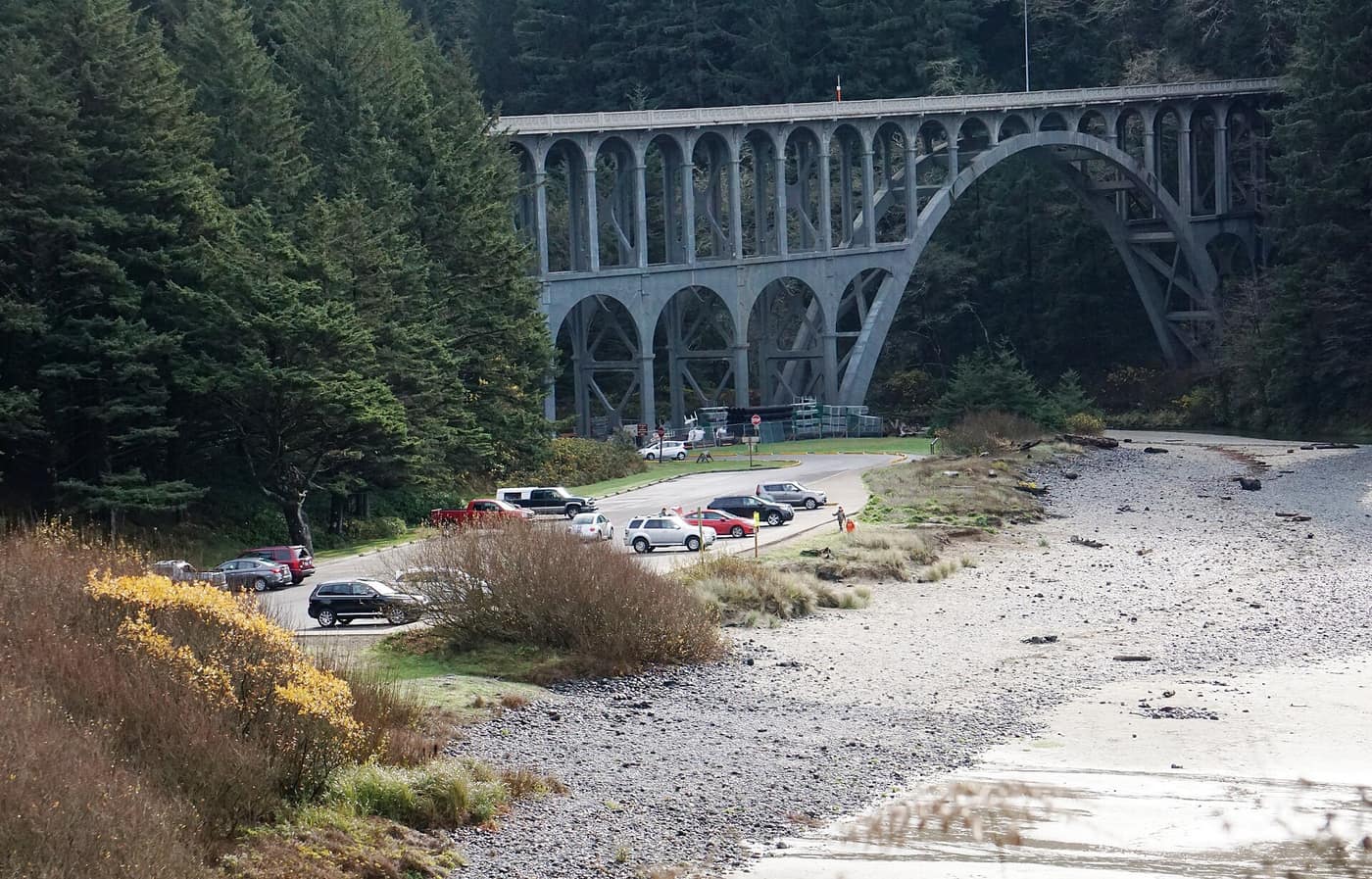
Cape Creek Bridge, seen from the lighthouse path below Heceta Head — Photo: Dankarl / Wikimedia Commons (CC BY-SA 4.0)
Sea Lion Caves: The Cave Next Door
Sea Lion Caves is a privately owned business, not a state or federal park, so its schedule, admission, and access rules are set by its owners and can change. We are deliberately not quoting any of that here. Check the Sea Lion Caves website for current hours and admission before you plan your day.
What the owners say about the place: it is a privately owned wildlife preserve and bird sanctuary operating since 1932, and the site describes the cave as America’s largest naturally formed basalt rock sea cave, more than twelve stories high and as wide as a football field. It is described as the year-round home of the Steller sea lion, and the sound of the animals is a big part of the experience.
Treat the size claims as the owners’ own description, and let them speak for the details of the visit. What we can say from the road is that the setting is a rugged stretch of coastline above the Pacific, which is reason enough to make the stop.
When Is the Best Time to Visit Heceta Head?
There is no wrong season, but each one is a different visit. According to state parks, whale watching is strong at Heceta Head during the winter and spring migrations, and sea lion and bird viewing are part of the draw. Common murres lay eggs on the rocks below the viewpoint railing, which makes the cliffs lively with birds. Summer brings easier walking and longer light; winter brings stormier skies and dramatic water.
Coast weather can change the plan in an hour, so bring layers and check the forecast. For road conditions on Highway 101, use TripCheck, and for the forecast, the National Weather Service.
Living Near Heceta Head
For people who fall for this stretch of coast, Florence is the practical home base: a river town with an Old Town waterfront, the dunes to the south, and Heceta Head and Sea Lion Caves a short drive north. Our Florence town guide covers the neighborhoods and what everyday life looks like, and the Oregon Dunes guide covers the other great landmark next door.
A lighthouse a short drive from town is not a small thing. It is also worth being honest that this is a working coast with real weather, so it helps to see it in more than one season before you decide. A home search here starts with how you want to spend your ordinary days.
Related reading
Previously on the blog: Yaquina Head: Newport’s Lighthouse and Tide Pools
Next up: Cape Arago and Sunset Bay: Coos Bay’s Wild Coastline →
Want a lighthouse for a neighbor?
Picture Heceta Head as your weekend walk, then let Phuong help you work out what financing a Florence home could look like.
Get Pre-Approved Talk Financing With Phuong